
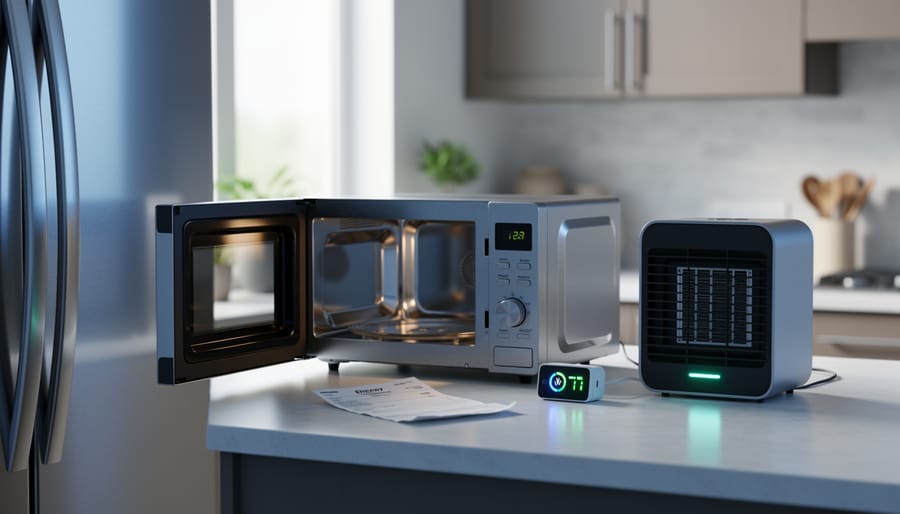
Understanding how much electricity your appliances consume translates directly to dollars on your monthly utility bill. An average household appliance operating at 1,000 watts (1 kW) for one hour costs between $0.10 and $0.30, depending on your local electricity rate. That means a refrigerator running continuously at 150 watts costs roughly $11 to $33 monthly, while a space heater at 1,500 watts can add $108 to $324 per month if used eight hours daily.
The primary cost drivers are appliance wattage, hours of operation, and your utility’s per-kilowatt-hour (kWh) rate. Most professionals and homeowners underestimate actual consumption because nameplates list maximum wattage rather than typical operating levels. A 2,000-watt microwave rarely pulls full power except during the first minute of heating, and variable-speed compressors in modern HVAC systems cycle power consumption throughout the day.
Calculating appliance operating costs requires converting watts to kilowatt-hours, then multiplying by your electricity rate and usage duration. This straightforward formula becomes powerful when you apply it systematically across all household devices. For solar energy professionals designing system capacity or homeowners evaluating energy efficiency upgrades, precise consumption data determines whether investments pay off.
This guide walks through the calculation methodology, breaks down where your energy dollars actually go, and compares DIY monitoring tools against professional energy audits. You’ll find an interactive calculator that accounts for real-world variables like standby power draw and seasonal usage patterns, helping you identify which appliances drive your costs and where upgrades deliver genuine savings.
How to Calculate Monthly Electricity Costs from Appliance Watts
Converting appliance wattage into monthly electricity costs requires a straightforward calculation that anyone can master. The fundamental formula multiplies your appliance’s power consumption by its usage time and your electricity rate, then accounts for the conversion from watts to kilowatt-hours.
The complete formula looks like this: Monthly Cost = (Watts × Hours per Day × Days per Month ÷ 1,000) × Electricity Rate ($/kWh).
Each variable plays a specific role. Watts measures the appliance’s power draw, you’ll find this on the nameplate, manual, or specification sheet. Hours per Day represents average daily runtime, not just when it’s plugged in but actively consuming power. Days per Month is typically 30, though you can adjust for actual billing cycles. The division by 1,000 converts watts to kilowatts, since utilities bill by kilowatt-hours. Your Electricity Rate in dollars per kWh appears on your utility bill, usually ranging from $0.10 to $0.35 depending on your location.
Here’s how to calculate monthly costs in practice:
- Identify your appliance’s wattage from its label or specifications, for this example, a 1,500-watt space heater.
- Estimate daily operating hours based on typical usage, say 6 hours per day during cold months.
- Determine days per month, using 30 for a standard calculation.
- Find your electricity rate on your utility bill, we’ll use $0.13 per kWh, close to the 2026 U.S. average.
- Plug the numbers into the formula: (1,500 × 6 × 30 ÷ 1,000) × $0.13.
- Calculate the kilowatt-hours first: 1,500 × 6 × 30 ÷ 1,000 = 270 kWh.
- Multiply by your rate: 270 × $0.13 = $35.10 per month.
That space heater running six hours daily costs you roughly $35 monthly at average rates. If you cut usage to three hours daily, the cost drops to about $17.50, demonstrating how runtime dramatically impacts your bill.
The same process works for any appliance. A 100-watt laptop used 8 hours daily costs around $3.12 monthly, while a 4,000-watt electric dryer run 5 hours weekly (roughly 0.71 hours daily) costs about $11 per month. Understanding this calculation reveals which appliances drive your electricity costs and where reducing usage or upgrading efficiency delivers real savings.
Monthly Cost by Appliance Wattage
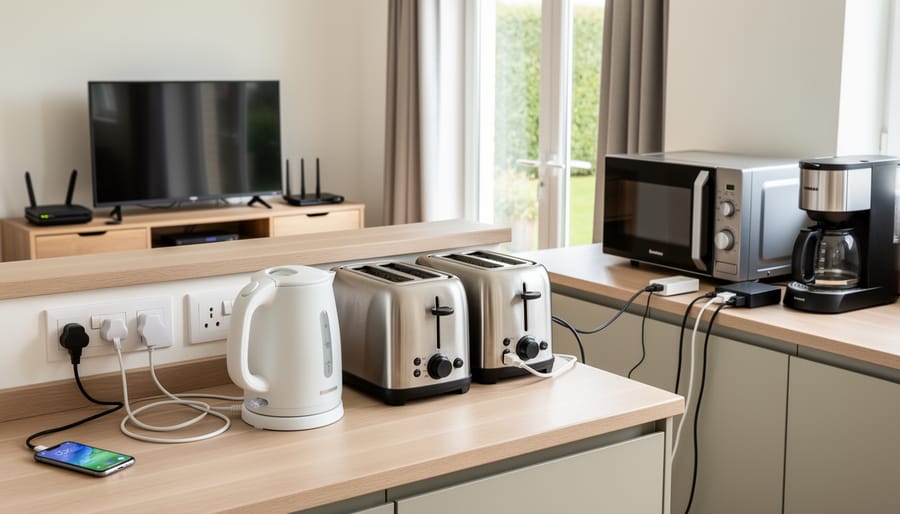
Understanding how appliance wattage translates to actual monthly costs helps you prioritize which devices to monitor, upgrade, or factor into solar system planning. The relationship between watts and dollars isn’t linear because usage patterns vary dramatically across appliance categories. A 1,500-watt space heater running eight hours daily costs far more per month than a 1,500-watt coffee maker used fifteen minutes each morning.
Low-wattage appliances (under 100W) typically cost between $1 and $8 monthly when used regularly. This category includes LED bulbs (10-20W), phone chargers (5-10W), alarm clocks (2-5W), and cable boxes (15-50W). While individually cheap to run, these devices often operate 24/7, accumulating costs through constant draw rather than high power demand. A 25-watt router running continuously at $0.15/kWh costs roughly $2.70 monthly, while ten LED bulbs at 15 watts each used six hours daily add another $4.05.
Medium-wattage appliances (100-1000W) represent the bulk of household electronics and produce monthly costs from $5 to $50 depending on usage intensity. Desktop computers (200-500W), televisions (100-400W), dishwashers (1,200W but short cycles), and window AC units (500-1,000W) fall into this range. A 300-watt desktop computer used eight hours daily at $0.15/kWh runs about $10.80 monthly. A 400-watt television watched five hours daily costs approximately $9 monthly. Usage duration matters enormously here: running that same TV twelve hours daily instead of five pushes the monthly cost to $21.60.
| Wattage Range | Typical Examples | Monthly Usage Hours | Monthly Cost ($0.15/kWh) |
|---|---|---|---|
| Under 100W | LED bulbs, chargers, routers | 240-720 hrs | $1-$8 |
| 100-1000W | TVs, computers, window AC | 120-300 hrs | $5-$50 |
| Over 1000W | Central AC, water heaters, dryers | 60-240 hrs | $25-$150+ |
High-wattage appliances (over 1000W) dominate your electricity bill despite often running fewer total hours. Central air conditioning systems (3,000-5,000W), electric water heaters (4,000-5,500W), electric dryers (3,000-5,000W), and electric ovens (2,000-5,000W) fall here. A 4,000-watt central AC unit running six hours daily during summer months costs approximately $108 monthly at $0.15/kWh. An electric water heater drawing 4,500 watts for three hours daily adds $60.75 monthly. These appliances justify priority monitoring because small efficiency improvements or usage adjustments yield significant dollar savings.
At higher electricity rates common in northeastern states ($0.25/kWh in 2026), these figures increase proportionally. That same 4,000-watt AC unit jumps to $180 monthly, while the water heater reaches $101.25. Conversely, in lower-rate regions ($0.10/kWh), costs drop by a third. Regional rate differences mean a medium-wattage appliance in Massachusetts might cost more monthly than a high-wattage appliance in Louisiana.
What Affects Your Monthly Appliance Electricity Costs
Regional Electricity Rate Variations
Electricity rates across the United States vary dramatically by region, and understanding these differences is crucial when using an appliance watts calculator to estimate your monthly costs. In 2026, residential 2026 state electricity prices range from lows around 10 cents per kWh in states like Louisiana and Washington (benefiting from hydroelectric and natural gas resources) to highs exceeding 30 cents per kWh in Hawaii, Alaska, and parts of New England. California and Massachusetts typically fall in the 25-28 cents range, while Midwest and Southern states often see rates between 12-16 cents per kWh.
This geographic variation means the same 1,500-watt appliance running four hours daily could cost you $18 monthly in Louisiana but $54 in Hawaii, a threefold difference based solely on location. States with regulated utilities, renewable energy mandates, or limited power generation infrastructure generally see higher rates, while those with abundant cheap energy sources and deregulated markets tend toward lower costs. When calculating your appliance expenses, always use your specific local rate, which you’ll find on your utility bill under the energy charge or cost per kWh.
Usage Patterns and Duration
Usage duration plays a more dramatic role in monthly costs than most people realize. An appliance drawing 1000 watts costs $3.60 per month if used one hour daily at $0.12/kWh, but that same appliance running 24 hours continuously costs $86.40 monthly, a 24-fold increase for the same wattage.
Continuous-use appliances like refrigerators, cable boxes, and aquarium pumps accumulate costs steadily. A cable box drawing just 30 watts costs $2.59 monthly when running 24/7. Intermittent-use devices like microwaves or hair dryers have high wattage but low monthly costs because they typically run only minutes per day. A 1500-watt hair dryer used 10 minutes daily costs just $0.90 monthly, while a 400-watt always-on dehumidifier costs $34.56.
The cost difference becomes stark when you track actual hours. A window air conditioner rated at 1200 watts costs $43.20 monthly running 8 hours daily, but jumps to $129.60 if left on 24 hours. This hours-multiplier effect means reducing usage time often cuts costs more effectively than replacing an appliance with a slightly more efficient model.
Appliance Efficiency and Power Factor
Modern appliances often consume less electricity than their rated wattage suggests, thanks to efficiency standards and power factor corrections. Energy Star appliances, for example, may draw 10-50% less power than minimum federal standards require. A refrigerator rated at 150W might average only 90W in actual operation due to compressor cycling and improved insulation.
Power factor measures how effectively an appliance converts electrical power into useful work. Older appliances with motors or transformers (like AC units or microwaves) typically have power factors between 0.5 and 0.85, meaning they draw more current than their rated wattage implies. Modern appliances incorporate power factor correction circuits that bring this closer to 1.0, reducing actual consumption. When using an appliance watts calculator, enter the nameplate wattage for a conservative estimate, but understand that actual monthly costs may run 15-30% lower with efficient equipment. For precise measurements, a Kill-A-Watt meter captures real-world consumption including power factor effects.
Cost Breakdown: Where Your Appliance Electricity Money Goes
Your appliance’s wattage only tells part of the story. When you calculate monthly electricity costs using an appliance watts calculator, the resulting dollar amount gets divided among multiple utility bill components, each adding to your total payment. Understanding this breakdown reveals which portions you can influence and where opportunities exist to reduce your overall electricity spending.
Energy Supply Charges
The largest portion of your bill, typically 50-65% of the total, covers the actual electricity generation. This is where your appliance’s wattage directly impacts costs, calculated as kilowatt-hours consumed multiplied by your supplier’s energy rate. In competitive electricity markets, you can sometimes shop for lower energy supply rates, making this the most controllable component of your bill.
Delivery and Distribution Charges
Roughly 25-35% of your payment goes toward maintaining the power grid infrastructure that delivers electricity to your home. These charges cover transmission lines, substations, and local distribution networks. Unlike energy supply charges, delivery fees are typically fixed by your local utility and remain constant regardless of which energy supplier you choose.
Taxes, Fees, and Surcharges
The remaining 10-15% consists of state and local taxes, renewable energy surcharges, system benefit charges, and various regulatory fees. These line items vary significantly by location, some states impose minimal charges while others add substantial taxes to electricity bills. You cannot directly control these costs, though they scale proportionally with your total consumption.
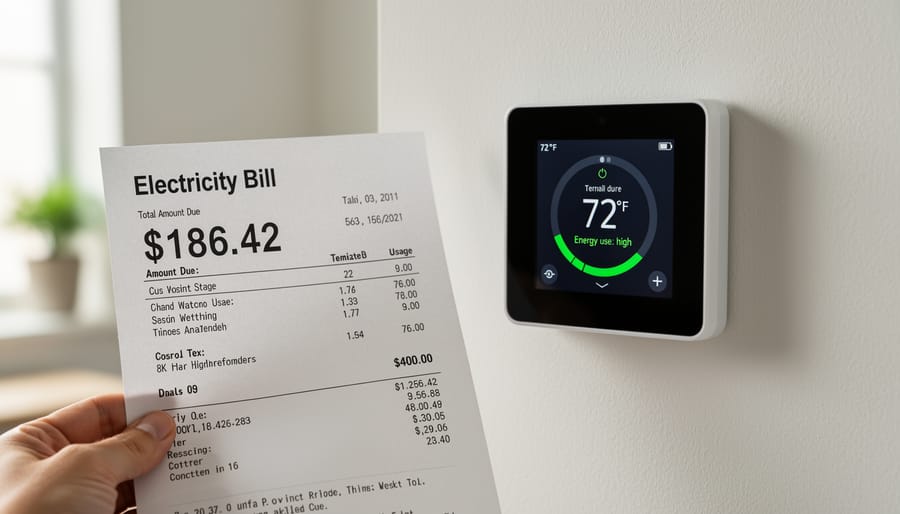
When you use an appliance watts calculator to estimate monthly costs, multiply your calculated energy expense by roughly 1.6 to account for all bill components. This means a $30 energy charge becomes approximately $48 total. Reducing high-wattage appliance usage primarily lowers the energy supply portion, but because other charges often scale with consumption, you decrease the entire bill proportionally.
DIY Monitoring vs. Professional Energy Audit
DIY Calculator and Kill-A-Watt Meter Approach
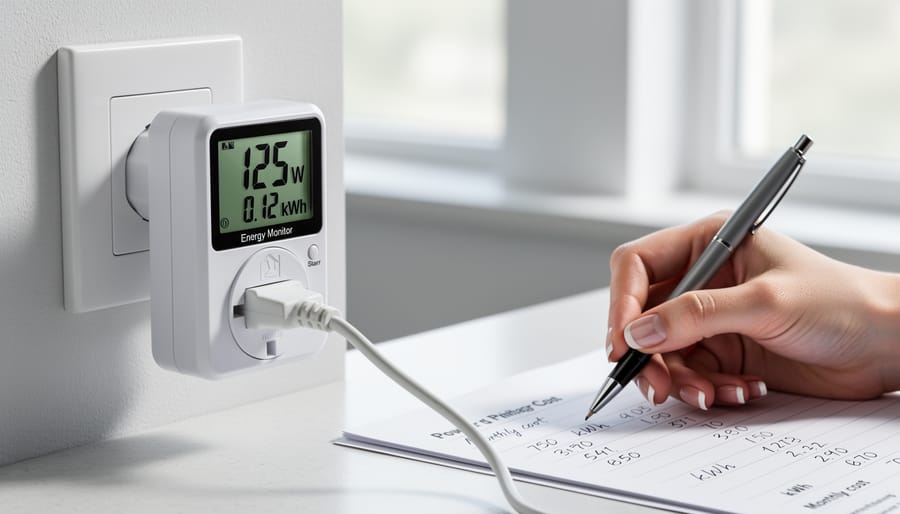
The DIY approach combines an online appliance watts calculator with hands-on measurement tools for accurate cost tracking. A Kill-A-Watt meter ($20-30) plugs between your appliance and wall outlet, displaying real-time wattage, accumulated kWh, and runtime hours. Higher-end models ($40-60) add cost tracking and power factor readings for more complete data.
Start by plugging your meter in and connecting your appliance. Run the appliance through typical use cycles for 24-48 hours to capture average consumption patterns, not just peak loads. The meter records both active wattage and standby power that nameplate ratings miss. For variable-speed appliances like refrigerators or HVAC units, week-long monitoring delivers the most reliable averages.
Once you have your measured wattage and usage hours, input these values into an appliance watts calculator along with your actual electricity rate from your utility bill. This combination typically yields accuracy within 5-10% of actual costs, far better than estimates based solely on nameplate ratings.
Best practice: measure your highest-usage appliances first (HVAC, water heater, refrigerator) since they drive 60-70% of residential electricity costs. Document your findings in a spreadsheet to track seasonal variations and identify the biggest savings opportunities before investing in efficiency upgrades or solar panels.
Professional Energy Audit Services
A certified energy auditor brings specialized equipment and expertise that goes well beyond basic appliance wattage measurements. Professional residential audits typically cost $200-500 and include whole-home analysis: blower door tests for air leakage, thermal imaging to identify insulation gaps, voltage and current monitoring at your electrical panel, and detailed appliance load profiling over 24-48 hours. Auditors measure phantom loads, assess HVAC efficiency, and identify voltage irregularities that affect appliance performance.
The comprehensive report you receive breaks down each appliance’s actual consumption with precise monthly cost projections based on your specific electricity rate structure and usage patterns. Most auditors also provide prioritized recommendations with payback calculations for efficiency upgrades, helping you decide whether replacing an old refrigerator or upgrading insulation delivers better returns.
This investment pays off when you’re planning major renovations, sizing a solar system (where accuracy matters for system design), managing commercial facilities with numerous high-wattage appliances, or when your electricity bills seem inexplicably high despite monitoring efforts. For a typical household with straightforward appliance usage, DIY methods combined with an appliance watts calculator often suffice. Consider professional audits when precision, comprehensive assessment, and expert recommendations justify the $200-500 expense, especially if you’re making $5,000+ decisions about solar installations or HVAC replacements.
Using the Appliance Watts to Monthly kWh Cost Calculator
The Appliance Watts to Monthly kWh Cost Calculator requires four basic inputs to generate accurate cost estimates. Start with appliance wattage, which you’ll find on the product nameplate, user manual, or manufacturer’s website. For devices without clear wattage ratings, look for amperage and voltage instead, multiply amps by volts to get watts. A device rated at 10 amps and 120 volts draws 1,200 watts.
Next, enter daily usage hours. Be realistic here: a refrigerator runs about 8 hours per day despite being plugged in 24/7 because the compressor cycles on and off. A laptop used for work might run 6-8 hours daily, while a coffee maker operates perhaps 30 minutes (enter 0.5). Track usage for a week if you’re unsure, then calculate the daily average.
The days per month field defaults to 30, which works for most calculations. Adjust it down if you’re estimating seasonal appliances, a space heater used only 15 days during cold snaps, for example, or an air conditioner during summer months.
For electricity rate, check a recent utility bill for the per-kWh charge. Don’t use the total bill amount; find the line item showing cost per kilowatt-hour. The national average in 2026 sits around $0.16/kWh, but rates range from $0.10 in Louisiana to $0.32 in Hawaii. Some utilities charge different rates for peak versus off-peak hours, use your highest rate for a conservative estimate, or average your tier rates if your bill shows graduated pricing.
Once you enter all four values, the calculator displays your estimated monthly cost and total kWh consumed. A 1,500-watt space heater running 6 hours daily for 30 days at $0.16/kWh costs $43.20 monthly and consumes 270 kWh. These numbers reveal which appliances drive your electricity bill and help size solar systems accurately. If you’re planning solar installation, add up the monthly kWh figures for all essential appliances to determine your baseline energy needs.
Run multiple scenarios to compare options. Calculate the cost difference between an old 400-watt desktop computer and a new 65-watt laptop, or compare your current 1,000-watt window AC unit against an 800-watt Energy Star model. The calculator makes these comparisons immediate and actionable.
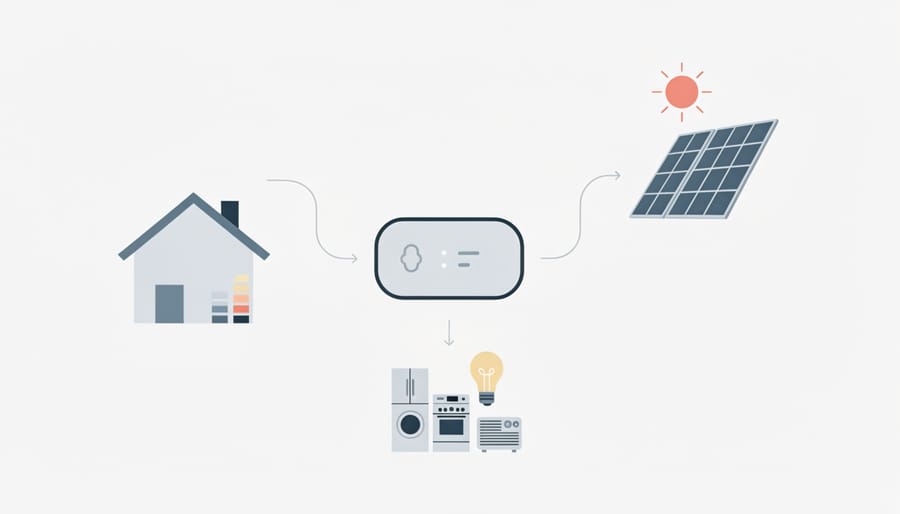
Common Appliance Wattage Reference
Knowing typical wattage values for common appliances helps you quickly estimate costs and identify the biggest drains on your monthly electricity bill. Appliance wattage varies significantly across categories, from low-power electronics to major HVAC systems that can consume several thousand watts during operation.
| Appliance Category | Typical Wattage Range | Average Daily Usage |
|---|---|---|
| Refrigerator/Freezer | 100-800W | 24 hours (cycling) |
| Central Air Conditioner | 2,000-5,000W | 8-12 hours (seasonal) |
| Electric Water Heater | 3,000-5,500W | 2-3 hours |
| Clothes Dryer | 2,000-5,000W | 1-2 hours |
| Dishwasher | 1,200-2,400W | 1-2 hours |
| Desktop Computer + Monitor | 200-500W | 4-8 hours |
Kitchen appliances show wide variation. Microwaves typically draw 600 to 1,200 watts during operation but run only minutes per day. Electric ovens consume 2,000 to 5,000 watts but represent intermittent usage. Coffee makers range from 800 to 1,400 watts, while toasters pull 800 to 1,500 watts during brief heating cycles.
HVAC systems dominate energy consumption in most homes. A central heating furnace fan uses 300 to 900 watts continuously during heating seasons. Window air conditioners vary from 500 watts for small units to 1,500 watts for larger models. Space heaters consistently draw 750 to 1,500 watts, making them expensive to run for extended periods.
Electronics and lighting represent smaller but continuous loads. LED TVs consume 50 to 200 watts depending on screen size, while older plasma models can exceed 400 watts. Laptop computers draw just 30 to 70 watts, far less than desktops. Modern LED bulbs use only 8 to 20 watts compared to 60 to 100 watts for incandescent equivalents.
For solar system planning or cost reduction strategies, focus first on high-wattage appliances with long daily runtime. A refrigerator at 150 watts running continuously costs more monthly than a 3,000-watt dryer used for one hour per week.
Frequently Asked Questions
How accurate is an appliance watts calculator for estimating my actual monthly costs?
An appliance watts calculator provides estimates within 5-15% of actual costs when you input accurate wattage, usage hours, and your specific electricity rate. Accuracy improves when you measure actual wattage with a Kill-A-Watt meter rather than relying on nameplate ratings, which often show maximum rather than typical consumption.
Where can I find the wattage rating for my appliances?
Check the metal nameplate or label on the appliance itself, usually located on the back, bottom, or inside the door. The label may show watts directly or list volts and amps, which you multiply together to get watts (Volts × Amps = Watts).
Can I use an appliance watts calculator to size a solar system?
Yes, calculating monthly appliance costs helps determine your total household load, which is essential for proper solar system sizing. Add up the monthly kWh consumption for all appliances, then work with a solar professional to design a system that covers your needs with appropriate battery capacity and panel output.
What’s the fastest way to reduce my monthly appliance electricity costs?
Focus on high-wattage appliances that run for extended periods. Replacing an old refrigerator with an Energy Star model, upgrading to LED lighting, using a programmable thermostat, and eliminating phantom loads by unplugging devices when not in use typically deliver the most significant savings.
The calculation methodology itself remains straightforward, but real-world application requires attention to several variables. Seasonal usage changes affect monthly costs dramatically for appliances like air conditioners or space heaters. A 1,500-watt heater running eight hours daily in January costs roughly $36 per month at $0.10 per kWh, but zero dollars in July when it sits unplugged.
Time-of-use electricity rates add another layer. If your utility charges peak rates during afternoon hours, running a dishwasher or clothes dryer at 9 PM instead of 6 PM can cut costs by 30-50% even though the appliance wattage stays identical. The calculator shows you the baseline cost, but you control when that consumption happens.
Power factor corrections matter for inductive loads like motors and compressors. A refrigerator rated at 150 watts might draw 180 watts from the grid due to reactive power requirements. Professional energy auditors account for these factors, while basic calculators use nameplate ratings. For most household planning, nameplate wattage provides sufficient accuracy, but expect 10-20% variance on motor-driven appliances.
Standby power consumption escapes many cost estimates entirely. Your television “off” still draws 5-15 watts for instant-on features. Cable boxes, printers, and coffee makers add phantom loads that collectively cost $100-200 annually in an average home. Calculate those watts over 24 hours daily, not just active use time.
Understanding how much your appliances actually cost to run each month puts you in control of your electricity expenses. The appliance watts calculator transforms abstract wattage numbers into real dollar amounts that affect your budget, whether you’re managing a household, planning a solar installation, or designing energy-efficient commercial spaces.
By calculating the monthly costs of your specific appliances, from your refrigerator running continuously to that space heater you use for a few hours daily, you gain visibility into where your energy dollars go. This knowledge reveals surprising cost drivers you might otherwise overlook and highlights which upgrades or usage changes deliver the biggest savings.
For solar professionals and homeowners considering renewable energy, accurate appliance power consumption data is essential for proper system sizing. Overestimate your needs and you overspend on panels and batteries; underestimate and your system won’t cover your loads. The watts-to-monthly-cost calculation provides the foundation for realistic solar planning that matches actual consumption patterns rather than guesswork.
Take ten minutes to run your major appliances through the calculator. Note which ones consume the most power relative to their value in your daily life. Use that information to prioritize energy-efficient replacements, adjust usage habits where practical, or size a solar system that genuinely meets your needs. Small changes, unplugging phantom loads, upgrading inefficient appliances, shifting high-wattage tasks to off-peak hours, compound into meaningful monthly savings when you know exactly what each device costs to operate.